
Shells in the Soil: How to Use Seashells in Your Garden
Seashell Supply on 18th Sep 2026
Seashells and gardens have been companions for centuries. Walk through the grounds of old coastal estates in England, wander the cottage gardens of New England fishing villages, or explore the courtyard of a Caribbean home, and you'll find shells incorporated into the landscape with an ease that feels entirely natural — because it is. Shells belong outdoors. They weather beautifully, they suit planted environments, and they bring the logic and palette of the shore into a space governed by entirely different natural forces. Here is a practical and creative guide to making the most of them.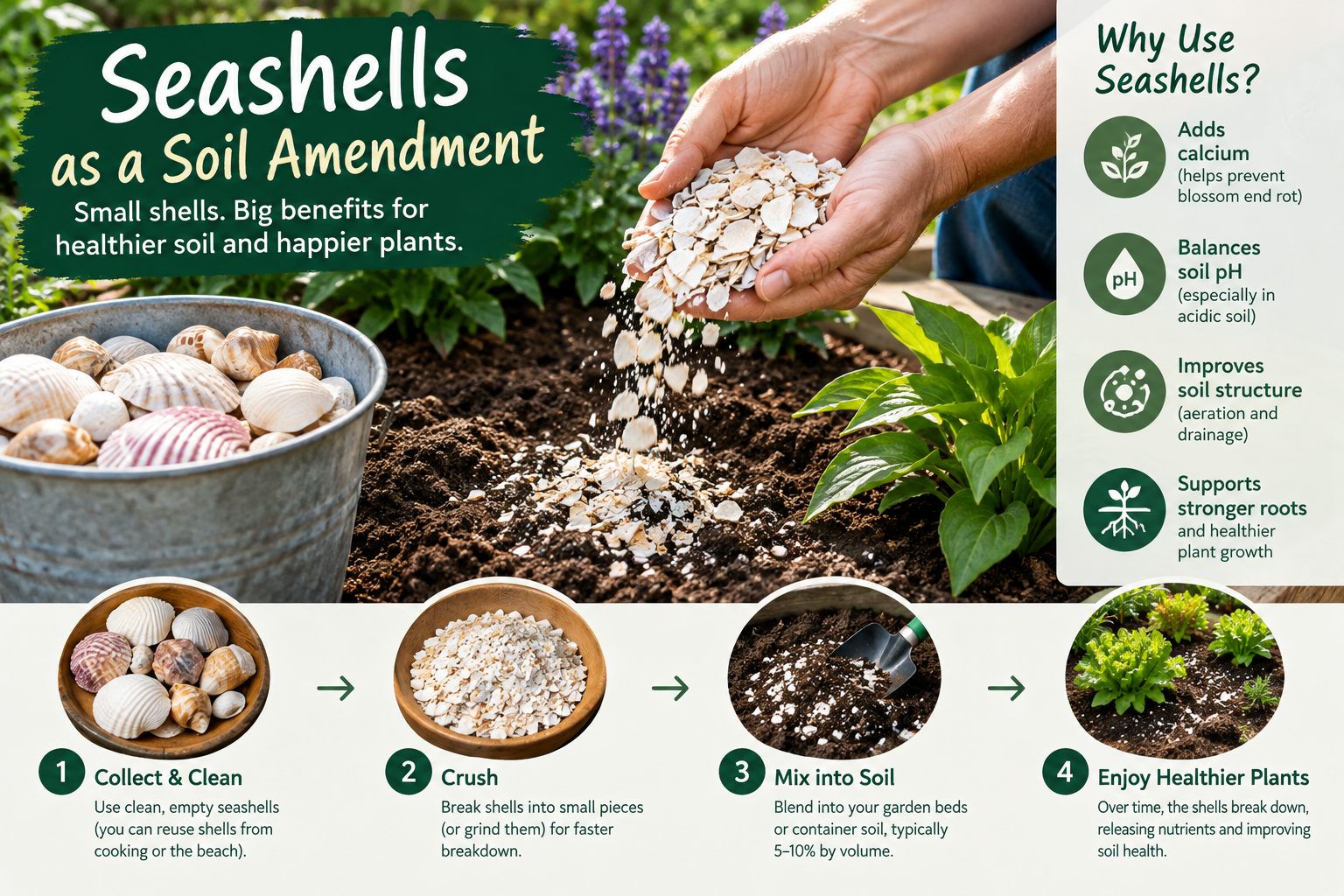
The Practical Case: Shells as a Soil Amendment
Before getting to aesthetics, it's worth understanding that seashells have genuine agricultural utility that gardeners have exploited for thousands of years. Shells are composed almost entirely of calcium carbonate — the same compound found in agricultural lime — and as they slowly break down in the soil, they release calcium and raise soil pH. For gardeners dealing with acidic soil, crushed shells are a slow-release liming agent that works over years rather than weeks, providing a gentler and more sustained correction than powdered lime.
Vegetables that are heavy calcium feeders — tomatoes, peppers, broccoli, kale, and other brassicas — benefit particularly from the slow calcium release of breaking-down shell material in the soil. Calcium deficiency in tomatoes is the cause of blossom end rot, one of the most frustrating problems home vegetable gardeners encounter. Incorporating crushed shells into the planting bed is a long-term preventative measure that also improves soil structure by adding mineral grit that aids drainage.
Crushing shells for soil amendment is straightforward. Place clean, dry shells in a heavy-duty bag and break them with a hammer or mallet until they're in pieces roughly the size of coarse gravel. Work them into the top several inches of soil in beds where they'll be most useful. They won't provide immediate results — this is a multi-season investment — but the cumulative effect on soil chemistry and structure is real and well-documented.
Mulch and Ground Cover
Whole or coarsely crushed shells make an excellent mulch alternative in ornamental beds, pathways, and around the base of trees and shrubs. Shell mulch does many of the same things organic mulch does — suppresses weeds by blocking light, retains soil moisture by reducing surface evaporation, and moderates soil temperature — while adding some things organic mulch doesn't. Shell mulch doesn't decompose quickly and need annual replacement the way bark or wood chip mulch does. It doesn't compact into an impenetrable mat. And it drains freely, which makes it particularly useful around plants susceptible to crown rot or in areas where water tends to pool.
Aesthetically, a shell mulch path or bed edging has a coastal, relaxed quality that suits informal garden styles beautifully. The pale, weathered tones of mixed shell mulch — creams, grays, soft tans — work particularly well against the dark greens of foliage plants, the silver-gray of lavender and artemisia, and the muted palette of ornamental grasses.
For a more formal effect, larger whole shells laid flat and close together create a surface that reads almost like irregular paving — not quite hardscape, not quite mulch, but something with its own distinct character. This works especially well in a dry garden or a garden with a Mediterranean or coastal design language.
Edging and Border Definition
Shell edging is one of the oldest and most widespread garden traditions in coastal communities worldwide, and it persists because it works. A border of shells along a garden bed does several things simultaneously: it defines the edge cleanly, it creates a visual transition between planted area and lawn or path, and it introduces the texture and color of the shore into the garden in a way that feels collected rather than manufactured.
The classic approach uses large whole shells — horse conchs, large clams, whelks, oyster clusters — half-buried in a line along the bed edge with their more visually interesting side facing outward. The half-burial is important both for stability and for appearance; shells sitting entirely on the surface look temporary, while shells set into the ground look intentional and permanent.
For a more uniform, refined look, matching shells of consistent size and species create a crisp, repeating pattern that suits more formal garden designs. For a more relaxed, eclectic effect, mixed shells of varying sizes and species arranged with attention to rhythm rather than uniformity feel more genuinely beachcombed and personal.
Containers and Planters
Large shells — particularly big conch shells, horse conchs, and large surf clams — make natural planters for small plants. The most practical approach is to use them as cachepots: set a small plastic nursery pot inside the shell, which provides drainage and makes changing plants easy without disturbing the shell. Succulents, small trailing plants like creeping thyme or sedum, and compact herbs all suit the scale and aesthetic of a shell container well.
For a garden table or outdoor windowsill, a grouping of shell planters at different heights creates a display that's both botanical and sculptural. The combination of living plant material and mineral shell — organic and inorganic, growing and fixed — has a natural tension that's visually interesting in a way that either element alone wouldn't be.
If you want to plant directly in a large shell without a nursery pot, use a gritty, fast-draining growing mix and be aware that shells have no drainage holes — meaning overwatering is the primary risk. Succulents and drought-tolerant plants that prefer to dry out between waterings are the most forgiving choices for direct shell planting.
Birdbaths and Water Features
Large, shallow shells make natural birdbaths when set level on a stable base — a flat stone, a section of log, an upturned terracotta pot, or a purpose-built pedestal. The natural bowl shape of large clam shells and surf clams holds water well, and birds seem entirely unbothered by the material. The shallow depth of most shell forms is actually ideal for birdbaths, which work best at one to two inches of water — deep enough for bathing, shallow enough to be safe.
A large shell set at ground level and filled with water becomes a ground-level drinking station for smaller birds, insects, and beneficial garden visitors. Grouped with a few smooth stones for insects to land on and a handful of pebbles to vary the depth, it functions as a simple wildlife water feature that requires nothing but occasional refilling and cleaning.
In larger water features — ponds, formal fountains, informal streams — shells can be incorporated as decorative elements along the edges or set into mortared surrounds. The combination of running water and shells is one of those pairings that feels so natural it seems almost inevitable.
Decorative Accents and Sculpture
Beyond functional applications, shells have a place in the garden simply as objects worth looking at. A large, beautiful conch set at the end of a path, or a grouping of interesting shells arranged on a garden wall or step, asks nothing of the viewer except attention — and rewards that attention with the same quiet complexity that makes shells interesting indoors.
Shells weather beautifully outdoors. The bleaching effect of sun and rain on shell exteriors — the gradual softening of colors, the development of a patina — suits the garden environment in a way that many manufactured ornaments don't. A terracotta pot looks worse for age; a conch shell looks better.
Shell wind chimes, discussed extensively in their own right, are a natural garden accent that adds sound to the visual dimension. Hung from a tree branch or pergola at a height where they catch the wind reliably, they produce a gentle, organic sound that suits an outdoor space in a way that metal or ceramic chimes sometimes don't.
Mosaic and Inlay Work
For gardeners interested in a more ambitious project, shell mosaic has a long tradition in garden design. Shell grottos — architectural follies encrusted entirely with shells in elaborate patterns — were a fashionable garden feature in 18th-century Europe, and while building a full grotto is an extraordinary undertaking, the same technique scales down to entirely manageable projects.
A garden stepping stone embedded with shells in a simple pattern is a weekend project requiring only ready-mix concrete, a mold, and a selection of shells pressed into the surface before the concrete sets. A section of garden wall decorated with shell mosaic — shells set into exterior tile adhesive in a pattern and grouted — is a more involved project but produces a permanent, weather-resistant result that improves the garden for decades.
Tabletops for outdoor furniture, the surrounds of outdoor mirrors, the faces of raised bed walls — all of these are surfaces that accept shell mosaic well and transform a functional object into something with genuine decorative character.
Attracting Wildlife
A less commonly discussed benefit of shells in the garden is their role as habitat for small wildlife. Empty shells provide shelter and nesting sites for small beneficial insects, and a pile of shells in a quiet corner of the garden functions as a modest insect hotel. Hermit crabs, if you garden near the coast, are active users of empty gastropod shells and will investigate and occupy any shells left accessible to them.
The calcium released by slowly decomposing shells in the soil benefits not just plants but earthworms, which require calcium for their own biological processes and thrive in soil with adequate calcium levels. More earthworms means better soil structure, better drainage, and better nutrient cycling — a cascading benefit that starts with a shell breaking down in the ground.
A Garden That Remembers the Shore
The deepest reason to use shells in a garden may be the simplest one. A shell in the soil or along a path carries the memory of a specific place — a particular beach, a particular morning, a particular moment of finding something beautiful and picking it up. Gardens are personal spaces, and the objects in them tell stories about the people who made them.
A border of shells collected over years of beach visits, each one a small souvenir of a specific time and place, turns a garden edge into something more than a horticultural feature. It becomes a record of a life lived with attention to the natural world — which is, in the end, what both gardening and shell collecting are really about.