
Why Do Seashells Have Different Shapes, Colors, and Patterns?
Seashell Supply on 16th Oct 2026
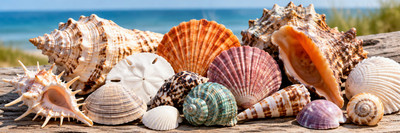
Pick up a handful of seashells, and you'll quickly notice that no two look quite alike. Some are smooth and rounded, while others have long spines, pronounced ridges, or intricate spiral patterns. Their colors range from brilliant white to warm orange, deep purple, and elaborate combinations of stripes and spots.
These differences are part of what makes seashells so fascinating to collectors, artists, educators, and anyone who appreciates the natural world. But seashells are more than beautiful objects. Their shapes, colors, and surface features reflect the biology of the animals that produced them and the environments in which those animals lived.
Understanding these differences can make a shell collection more interesting and help you make more informed choices when selecting shells for display, study, or creative projects.
First, What Exactly Is a Seashell?
Most familiar seashells are the hard external structures made by marine mollusks. These animals include gastropods, such as many snails, and bivalves, such as clams, mussels, and scallops.
A shell provides protection and structural support for the animal. It is formed by tissues in the mollusk's body, which deposit shell material in layers as the animal grows.
The shell isn't simply a covering that an animal finds and inhabits. For the mollusk that produces it, the shell is an integral part of its body.
Different groups of mollusks have evolved different shell structures to suit their lifestyles. This is why a clam shell looks so different from a spiral-shaped snail shell, even though both serve protective functions.
Why Are Some Seashells Spiral-Shaped?
Spiral shells are among the most recognizable forms found along coastlines and in shell collections.
Many gastropods produce shells that expand as the animal grows. Rather than building an entirely new shell each time it becomes larger, the animal adds material around the existing structure.
In many species, this growth produces a spiral. The exact shape depends on the species and how its shell expands over time.
Some spirals are broad and rounded, while others form tall, narrow towers. The opening, or aperture, can also differ substantially in size and shape.
These variations are useful when identifying shells. The overall outline, the proportions of the spiral, the shape of the opening, and the presence of ridges or spines can all help distinguish one kind of shell from another.
Spiral shells also offer a natural sense of movement and balance, which explains their appeal in decorative displays and artistic arrangements.
Why Do Clam and Scallop Shells Look Different?
Clams, scallops, and other bivalves have shells made of two connected valves. Although they share this basic structure, their shapes can vary dramatically.
Many clam shells have rounded or elongated outlines. Scallop shells are often fan-shaped, with ridges radiating outward from the hinge. Mussel shells tend to be elongated, while some other bivalves have more irregular forms.
These differences reflect each species' anatomy, growth, and way of life.
The shell's thickness, curvature, and surface texture may also vary. Some species have relatively smooth surfaces, while others develop strong ridges or growth lines.
For shell enthusiasts, these characteristics provide an easy starting point for comparing specimens. For artists and decorators, they offer a wide range of natural forms to work with.
Fan-shaped shells, for example, can create repeating patterns in mosaics, while rounded shells can provide visual balance in displays.
What Determines a Seashell's Color?
Shell color is one of the first features people notice, but it can be influenced by several factors.
In many mollusks, pigments incorporated into the shell during growth produce colors and patterns. Depending on the species, these may appear as bands, spots, zigzags, or more complicated markings.
Genetics, environmental conditions, diet, and other biological factors can influence coloration. Their effects differ among species, so a single explanation doesn't account for every shell.
Some shells have strong contrasting patterns, while others appear nearly uniform. Even individuals of the same species may show noticeable variation.
It's also important to distinguish a shell's original coloration from changes that occur later. Sunlight, abrasion, weathering, and exposure to the elements can alter a shell's appearance. A shell found on a beach may look different from a recently collected specimen of the same species.
This natural variation is one reason shells are so appealing for creative work. A collection of shells in similar shapes may still provide an assortment of colors and patterns.
What Causes Iridescent Shells?
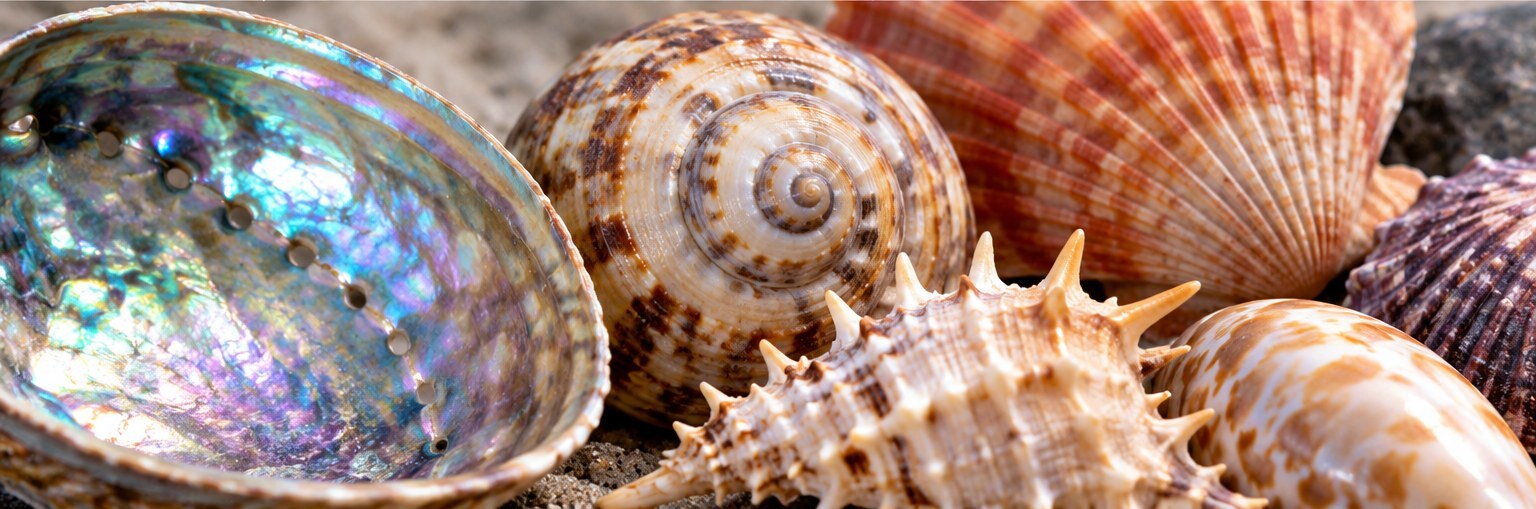
Some shells display a shimmering effect that changes as the viewing angle or lighting changes. Abalone is a familiar example of this phenomenon.
In certain shells, the internal structure of the shell material interacts with light, producing iridescence. This optical effect can create flashes of green, blue, purple, pink, or other colors.
The result is different from simply having a pigment-colored surface. Instead, the appearance depends partly on how light interacts with the shell's microscopic structure.
Iridescent shells can be especially striking when displayed under soft, indirect lighting. They also make distinctive accents in jewelry, decorative arrangements, and mixed-media artwork.
When selecting these shells for a project, consider how they'll be viewed. A shell that looks subtle in one position may become much more colorful when angled toward a light source.
Why Do Some Seashells Have Spines, Ridges, or Bumps?
Not all shells are smooth. Many have elaborate surface features, including knobs, ribs, spines, and raised ridges.
These structures develop as the shell grows, and their functions vary among species. Depending on the animal and its environment, shell features may contribute to defense, structural strength, camouflage, or interactions with the surrounding habitat.
For example, a shell's spines may make it more difficult for some predators to handle or swallow the animal. Ridges and other surface structures can also affect the shell's strength and shape.
However, it's important not to assume that every visible feature has the same function across all species. Shell structures have evolved in different ways, and their significance depends on the particular animal.
From a design perspective, textured shells provide contrast that smooth shells cannot. A collection combining ridged, spiny, glossy, and matte surfaces can create an especially interesting display.
Can You Identify a Shell by Its Appearance Alone?
Appearance is an excellent starting point, but accurate identification often requires looking at several characteristics together.
Consider these features when examining a shell:
- Overall shape: Is it spiral-shaped, fan-shaped, elongated, or made of two valves?
- Surface texture: Is it smooth, ridged, spiny, or covered in bumps?
- Opening or hinge: What does the opening look like, or how are the two valves connected?
- Color and pattern: Are there bands, spots, stripes, or contrasting areas?
- Size and proportions: How does the shell's length compare with its width?
- Location and habitat: Where was the shell found, and what species occur in that region?
A photograph or a single color characteristic may not be enough to establish a species. Shells can change as they weather, and unrelated species sometimes develop similar appearances.
If you want to identify a specimen accurately, compare multiple features with a reliable regional field guide or specialist reference.
What Seashells Can Teach Us About the Ocean
Seashells provide a tangible connection to marine biology. They reveal something about the remarkable diversity of mollusks and the many ways animals have evolved to survive in aquatic environments.
They also offer a useful introduction to broader scientific topics, including adaptation, growth, biological classification, and the relationship between organisms and their habitats.
For teachers and parents, shells can become hands-on educational tools. Children can sort specimens by shape, compare patterns, measure dimensions, and practice describing observations without needing to identify every species.
Collectors can take a similar approach by organizing their collections around shell structure, broad animal groups, or geographic origin.
Explore the Diversity of Seashells
The next time you examine a seashell, look beyond its color or overall beauty. Notice the shape of its opening, the direction of its ridges, the structure of its spiral, or the way its surface catches the light.
Each feature offers a clue to how that shell formed and how the animal that produced it lived.
Whether you're interested in marine science, building a collection, teaching children about the natural world, or finding distinctive materials for art and decoration, the diversity of seashells provides endless opportunities for discovery.
Explore different shell types and compare their natural shapes and patterns to find the specimens that interest you most. The more closely you look, the more there is to learn.